Speaking the Language of the Brain
The human brain is nature’s ultimate supercomputer. It continuously processes a massive stream of multi-sensory information, commands intricate movements, and learns dynamically—all while consuming only about ~20W of power. But what happens when this incredible network experiences a disruption?
Neurological disorders represent one of the most complex challenges in modern healthcare. Epilepsy, for instance, affects approximately 50 million people worldwide. For decades, our primary approach to such conditions has been pharmacological, but we are now standing at the threshold of a new era in regenerative medicine. Brain-Machine Interfaces (BMIs) offer the tantalizing promise of interacting directly with neural circuits to monitor, detect, and mitigate neurological anomalies.
However, to truly achieve a seamless integration between technology and biology, we face a massive engineering roadblock: our traditional computers don’t speak the brain’s language.
The Power and Language Barrier
If we want to communicate with biological tissue “peer-to-peer,” traditional digital computing architectures fall short. They are rigid, synchronous, and far too power-hungry. You cannot safely or efficiently implant a system into the human body that requires the energy equivalent of a desktop processor.
We need a completely different paradigm. We need systems that match the brain’s extraordinary energy efficiency and its asynchronous, spike-based nature.
The Neuromorphic Shift: Microelectronics and Memristors
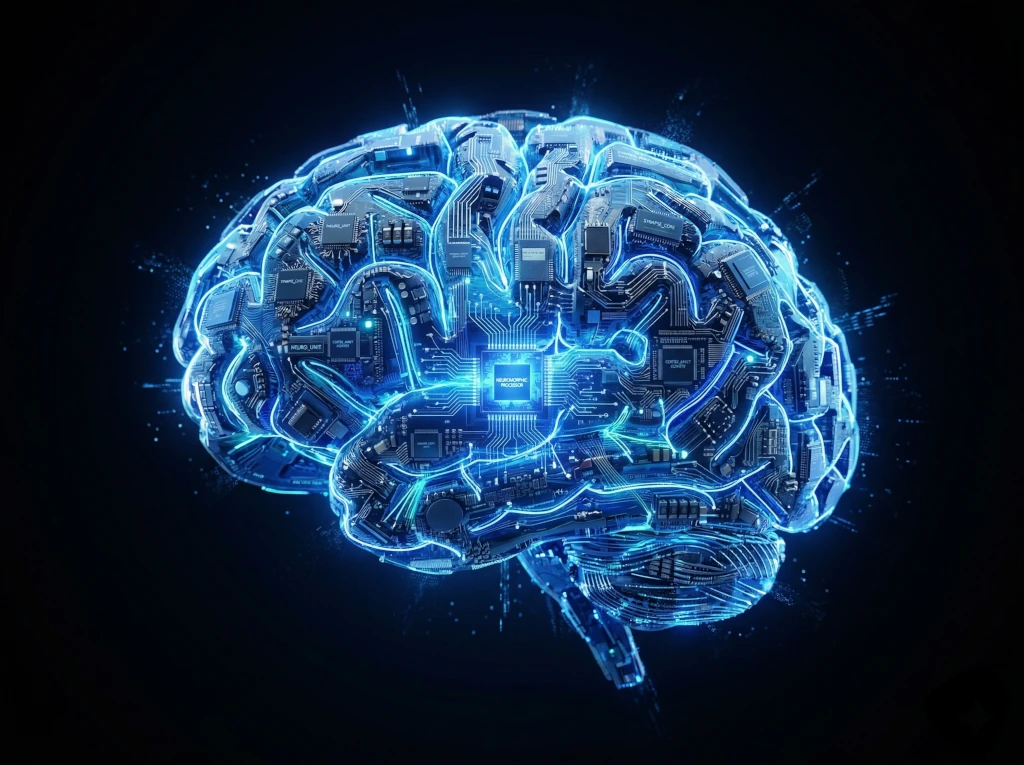
This is where neuromorphic engineering comes into play. Instead of forcing brain signals into traditional computational models, engineers are building microelectronics inspired by the physical structure of the brain itself.
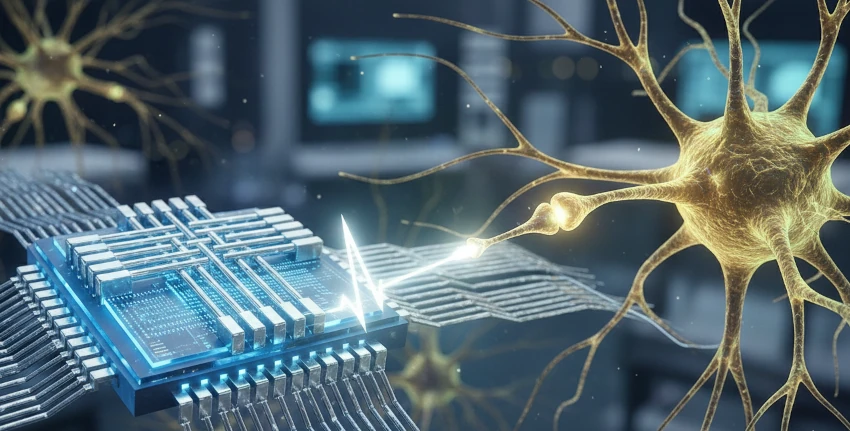
The key to this revolution lies in emerging nanoscale components called memristors. These incredibly tiny devices act essentially as artificial synapses. What makes them so special for brain-machine interfaces?
- Extreme Efficiency: Memristors require remarkably little space and power, bringing the energy footprint of artificial neural networks much closer to biological realities.
- Physical Learning: Unlike traditional software that simulates learning, memristors can physically adapt. Through a mechanism known as Spike-Timing-Dependent Plasticity (STDP), these devices adjust their electrical resistance based on the timing of the signals they receive. In plain English: the hardware itself “learns” from the bio-signals it processes, much like our actual neural connections strengthen or weaken over time.
The Crucial Step: Testing Before In-Vivo
The potential of an implantable chip that can independently learn to detect and stop an epileptic seizure is thrilling. However, bringing this technology to the clinic is a marathon, not a sprint. Before we can even consider testing these devices in-vivo (in living biological tissue or human patients), rigorous validation is essential.
Safety and reliability are paramount. This is why current research heavily relies on closed-loop emulations. By generating artificial brain activity—such as using mathematical models of the brain’s hippocampal loop—we can simulate the onset of epileptic seizures. We can then connect our neuromorphic hardware to this simulation to see if it can successfully interpret the signals, learn the patterns, and trigger a response to inhibit the seizure in real-time.
These in-silico and hardware-in-the-loop tests are the ultimate proving ground. They allow us to refine the learning algorithms and ensure the microelectronics behave predictably before exposing living tissue to the system.
Looking Ahead
We are not at the finish line yet. Solving the challenges of biocompatibility, long-term stability, and patient-specific tuning will take years of collaborative effort across multiple scientific disciplines.
However, the shift toward neuromorphic, memristor-based hardware represents a fundamental leap forward. By finally building technology that speaks the biological language of spikes and synapses, we are laying the groundwork for a future where intelligent, low-power brain implants can restore quality of life to millions of people. It is a small step for a microchip, but a giant leap toward a healthier world.